A self-service platform for grades 3 to 12. Students review a personalized lesson aligned to their curriculum, then work through short practice sessions in math, science or history at their own pace, with nothing to schedule and no class to join. Before a topic counts as done, they have to explain how they got the answer, not just give it. A report you can actually read follows every session.
Lesson
Comparing fractions
Refresher, key points, definitions
Grade 4 · CCSS 4.NF.A.2Practice session
Report
7.4/10
A self-service practice platform for grades 3 to 12, covering math, science and history. Your child picks the topic their class is covering. The platform writes a short lesson for it, pitched at what they already know, then asks them to work through it and say how they reached each answer. Nothing is scheduled and nobody has to be booked. It runs alongside whatever they are already taught, at public school, private school, or home.
Nothing to schedule and no class to join. It does not replace what school is teaching. You pick the topic their class is covering, and the practice is built around what this particular child already knows.
Subject first, then the specific piece: grade 4 fractions, comparing ones with different denominators. Everything is mapped to Common Core, so you can match what their class is covering this week.
A few minutes of key points and definitions on that topic, written for what this child has already shown they know. Not a curriculum, and not the same one twice.
A short set of questions on the topic, adjusted as the student answers. A child who has already shown they can do the straightforward version does not get handed it again.
For each one the student says how they got there, not just what the answer was. When they are stuck the platform does not hand it over. It asks a smaller question and waits.
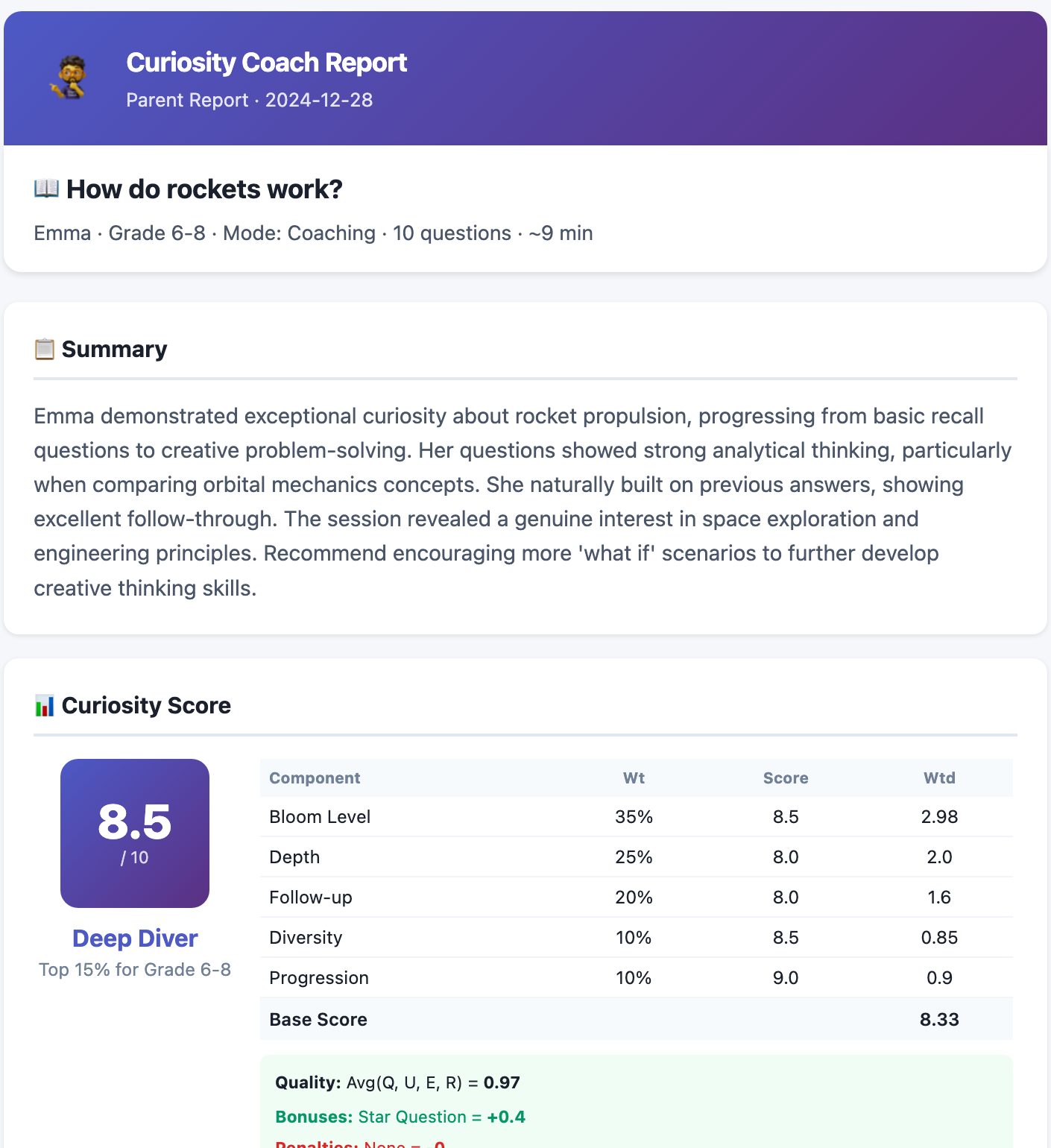
About fifteen minutes later a plain-language report arrives: what they practiced, where the reasoning wobbled, and the one thing to work on next. It takes two minutes to read.
One record follows the student from session to session. The next topic is pitched off what the last one showed, so the questions get harder as they get better, and you can see the scores move.
Anything in Common Core, plus whatever they bring from outside it. Four examples:
The lesson covers the rule. The session asks why it works. A child who can explain why you flip the second fraction stops forgetting it.
Hypotheses, evidence, and what would change their mind. The habits a science fair project is supposed to build.
Causes, evidence, and who was telling the story. Harder than it looks, and the best training for reading anything else.
What is being claimed, what the evidence is, and who gains if you believe it. The same questions, aimed at what they actually watch.
A child remembers a topic when they have had to explain it, not when they picked an answer and moved on. The whole platform is built on one idea: nobody has really learned something until they can put it in their own words.
The platform checks your child has actually understood it, not just recognized the shape of it. It gives them a fresh example of the same idea and asks them to work it through out loud. Then it keeps pushing: why does that step work, what changes if the numbers change, where does the rule stop applying.
What changes first is usually not the grade.
“He kept asking it for the answer and it kept asking him questions back. He was pretty annoyed the first week. Now he just gets on with it.”
“I figured I’d skim the report and forget about it. Instead I could see the exact point she stopped trying, and we ended up talking about that instead of her grade.”
“I’m the one who’s supposed to notice when something hasn’t clicked. This spots it before I do, and tells me which part.”
Most learning apps show you a progress bar. After every session you get a scored report, and the conversation it came from. The questions your child asked, where they got stuck, what to work on next, and how that has moved since last time.
You see where the thinking went wrong, not just which answers were wrong.
Approved ClassWallet vendor. Pay by card, or with your education savings funds.
Request an invoice from us, submit it in ClassWallet, and the payment comes straight out of your balance. Nothing leaves your own account.
Buy with any card and we email an itemized receipt the same day. Upload it in ClassWallet under educational software or curriculum. Reimbursement typically lands in five to ten business days.
If your program gives you a debit card, use it at checkout like any other card.
Whichever route you take, you get an itemized receipt or invoice with your child’s name on it. That is the document these programs ask for.
Written as a specification, not a pitch.
A self-service online practice platform for math, science and history.
Category: educational software / curriculum
Grades: 3 to 12
Not a tutoring service. Nothing is scheduled, nothing is delivered live, and no instruction comes from a person.
A student works through practice on their own time. The platform asks the follow-up questions and scores the reasoning.
Itemized invoice or receipt carrying the student’s name, provided on request.
Vendor registration documents, including a W-9, available on request. Approved ClassWallet vendor.
COPPA and FERPA compliant. No advertising, no data sold. Full policy below.
No. This is self-service software. There is no live tutor and nothing to book. A student works through practice independently, on their own time, and the platform asks the follow-up questions.
No. There is no calendar and no sign-up window. Practice is available whenever your child is ready.
The platform does not give the answer outright. It asks a smaller question so they can find the step they missed themselves.
ChatGPT is built to give the answer. This is built to withhold it. The lesson teaches the key points and definitions up front, the way a good teacher would. What it will not do is hand over the answer to the work itself. Your child has to reason it through and explain it. If they push for the answer, the platform declines and asks a question that moves them one step closer.
About fifteen minutes, taken whenever your child finishes a lesson or a chapter. There is no schedule to keep up with, and the report takes two minutes to read.
Grades 3 to 12. The questions adjust to the grade you set. Below grade 3 a child is usually still building the writing fluency the session depends on, so we do not sell it for those grades.
Topics are mapped to Common Core and organized by grade, so you choose what their class is covering now and the lesson is built for it.
No. Lessons follow the topics your child is already covering and go deeper on them. It works alongside school or any homeschool program.
Their name, grade level, the questions they ask, and the session itself. Never photos, precise location, contact lists, or social accounts. A parent consents before a child can use it, can read everything their child has done, and can have all of it deleted. Child data is never used for advertising and is never sold.
Sessions are processed by Anthropic’s API, in the United States. We send the conversation and a non-identifying student name. We do not send email addresses, IP addresses, or device data. Transcripts do not train any model: Anthropic’s commercial API terms exclude our inputs and outputs from training, and they are held for up to 30 days for safety review only.
Data is kept while the account is active and deleted after 24 months without use. Email support@cogitocoach.com and it is deleted within 30 days. You can also ask for a copy of everything we hold. Schools can request a data processing agreement, and we notify them within 72 hours of any security incident. COPPA and FERPA compliant. Read the full privacy policy
Yes. We are an approved ClassWallet vendor. You can have us invoice your account directly, pay by card and claim it back with the itemized receipt we send you, or use a program debit card at checkout.
In 1984 Benjamin Bloom reported that a student working one to one with a tutor outperformed 98% of students taught the same material in a classroom. Two standard deviations. It is a contested figure, argued over ever since, and nobody has reliably reproduced it at scale. Everyone is still chasing it, because what made tutoring work was never the extra content. It was a person asking the next question, noticing the shaky answer, and refusing to let a student move on from something they had only half understood.
Bloom’s taxonomy. Six levels of thinking, from remembering a fact to judging an argument. The questions keep moving up the levels instead of settling for recall.
Zone of proximal development. Vygotsky’s finding that learning happens just past what a child can already do alone. Questions are pitched there, not at what they have mastered.
The Socratic method. Two and a half thousand years old, and still the most reliable way to make someone examine their own reasoning.
Cognitive bias research. Where reasoning predictably goes wrong. Naming those patterns early turns a confident wrong answer into a checkable one.